
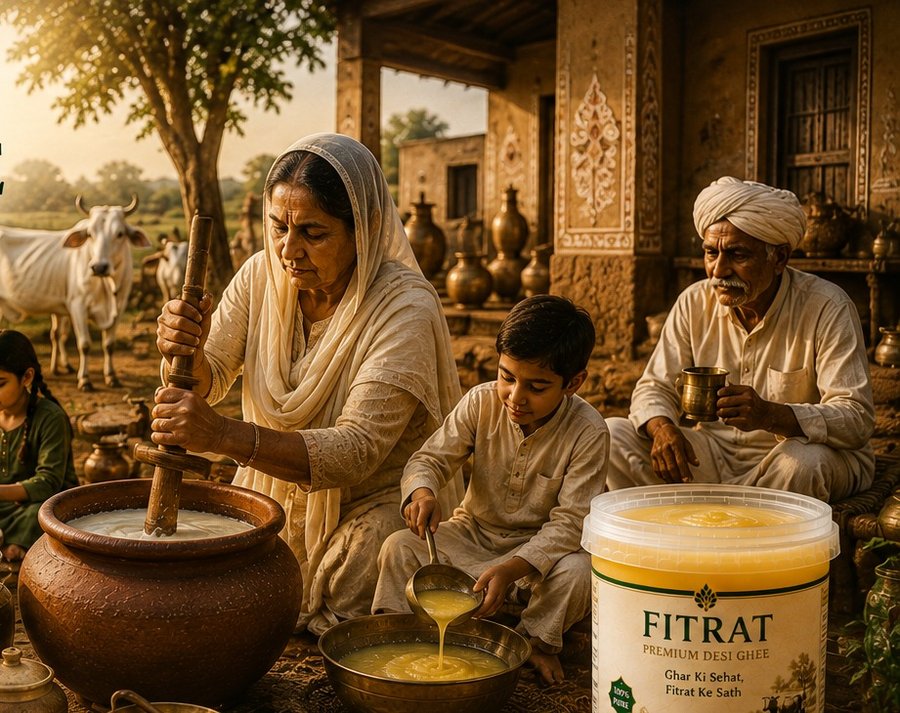
Many Pakistani shoppers search for a simple way to identify pure desi ghee at home.
The honest answer is important:
Household observations can provide clues, but no single kitchen test conclusively proves a product's complete composition or purity.
1. Check the label first
Before trying a kitchen test, read:
- Ingredients
- Net weight
- Brand/manufacturer
- Storage information
- Contact details
Transparent product information is more useful than a viral test.
2. Observe colour and texture
Ghee can naturally vary in colour and texture.
Temperature and milk source can affect appearance.
Therefore: colour alone is not proof of purity.
3. Smell the ghee
A normal dairy-ghee aroma can be a useful sensory clue.
An unusual chemical, rancid or contaminated smell deserves attention.
But aroma alone cannot prove purity.
4. Observe melting behaviour
Ghee softens and melts as temperature rises.
Watching this can tell you something about texture and temperature response, but it cannot conclusively identify every ingredient.
5. Be careful with viral purity tests
Online advice may claim that a water test, palm test or colour test proves purity.
Treat these as informal observations — not laboratory analysis.
For conclusive questions about composition or adulteration, appropriate laboratory analysis is more reliable.
A practical buying checklist
Before buying, check:
- Ingredient list
- Net weight
- Seller/manufacturer identity
- Storage information
- Quality information
- Customer support
- Purchase record
FAQs
How can I test pure desi ghee at home?
Does grainy ghee mean it is pure?
Does melting in the palm prove purity?
What is the most reliable way to confirm purity?
Key takeaway
Use sensible consumer checks, but do not treat any single home test as laboratory proof.
FITRAT CTA: Explore FITRAT's current Desi Ghee pack sizes and prices, and place your order directly on WhatsApp.
View FITRAT Desi Ghee